Gold's Track Record as an Investment in Australia
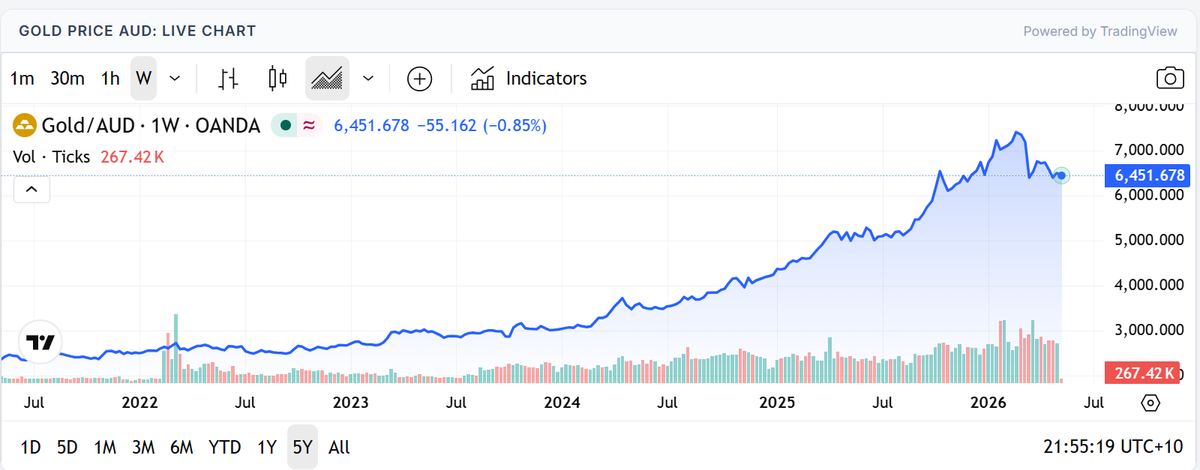
Gold has a long history as a store of value, but its performance as an investment depends heavily on the currency and time period you measure. For Australian investors, the relevant benchmark is the AUD gold price.
Over the decade to 2025, the AUD gold price increased from approximately $1,600 per ounce to over $4,800 per ounce, a roughly threefold increase. This performance was driven by a combination of rising USD gold prices and periods of AUD weakness, which amplifies USD gold gains when converted to Australian dollars.
Gold does not pay dividends or interest. Its return is entirely price appreciation. In periods of low inflation and strong equity markets, gold often underperforms shares. In periods of high inflation, financial stress, or currency weakness, gold tends to perform relatively well.
See the current gold price in AUD with live updates throughout the trading day, or check the silver price in AUD if you are comparing both metals.
Why Australian Investors Buy Gold
Australian investors cite several reasons for holding gold as part of a diversified portfolio.
Inflation protection is the most common reason. Gold has historically maintained its purchasing power over long periods, even as currencies have lost value to inflation. For investors concerned about the long-term purchasing power of the Australian dollar, gold offers a form of insurance.
Currency diversification is another driver. Gold is priced globally in USD. When the AUD falls against the USD, the AUD gold price rises automatically. Australian investors holding gold therefore benefit from a natural hedge against AUD weakness, which often occurs during periods of economic stress when AUD-denominated assets are also under pressure.
Portfolio diversification matters too. Gold's price movements tend to have low correlation with Australian shares and property over most time periods. Adding a modest allocation of gold to a portfolio can reduce overall volatility without proportionally reducing expected returns.
Finally, some investors hold gold as a tail risk hedge. In scenarios involving financial system stress or severe inflation, physical gold's value as a tangible, portable, and universally recognised asset becomes particularly relevant.

Gold vs Shares vs Property in Australia
Gold is not a substitute for shares or property. Each asset class serves a different role in a portfolio.
Australian shares via the ASX or managed funds offer dividend income, franking credits, and the potential for capital growth linked to corporate earnings. Over most 20-year periods, broadly diversified Australian equities have outperformed gold on a total return basis. But shares carry volatility, and their correlation with the economic cycle means they often fall precisely when investors most need stability.
Residential property in Australia has delivered strong long-term returns but requires large capital commitments, creates illiquid positions, involves significant transaction costs, and carries ongoing expenses for maintenance, insurance, and council rates. Gold by contrast is highly liquid, divisible, and has minimal ongoing cost beyond storage and insurance.
The practical comparison for most investors is not gold versus shares or gold versus property, but gold as a component of a diversified portfolio alongside shares and property. An allocation of 5 to 15 percent to gold is commonly cited by financial planners as appropriate for investors who want the diversification benefit without over-allocating to a non-income-producing asset.
Risks of Investing in Gold
Gold is not a risk-free investment. Its price can fall significantly over short periods and can underperform other asset classes for years at a time.
Between 2013 and 2018, the USD gold price declined by approximately 30 percent from its 2011 peak before recovering. Australian investors experienced a less severe drawdown because the AUD also weakened over that period, partially offsetting the USD price decline. But gold can and does lose substantial value over periods measured in years.
Gold does not generate income. Unlike shares that pay dividends or bonds that pay interest, gold held in storage pays nothing. In a strong equity market where shares are generating 8 to 10 percent annual returns, the opportunity cost of holding gold can be considerable.
Physical gold also has storage and insurance costs. These are generally modest, typically 0.5 to 1 percent of value per year depending on the provider, but they represent a real drag on returns over long periods.
Finally, the premium over spot paid to a dealer on purchase, combined with the spread between buy and sell price, means you need meaningful price appreciation before returning to break even after costs. This makes short-term trading in physical gold expensive and generally unsuitable.
How to Buy Gold in Australia
There are several practical ways for Australian investors to gain exposure to gold.
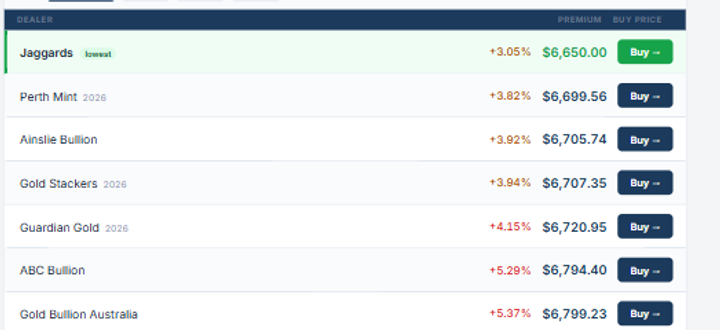
Physical bullion is the most direct route. You buy actual gold coins or bars from an Australian dealer and take delivery or store them with the dealer or an independent vault. The main advantage is that you own the physical metal outright, with no counterparty risk. Our gold coins comparison and gold bars comparison show live prices from all major Australian dealers including Perth Mint, ABC Bullion, Ainslie Bullion, and Guardian Gold.
ASX-listed gold ETFs such as GOLD trade like shares and track the gold price. They are convenient and liquid, but you do not own physical gold directly. You own units in a fund that holds gold on your behalf.
Gold mining shares and managed funds provide leveraged exposure to the gold price, but they also introduce company-specific and operational risks that are absent from owning the metal itself. Mining shares can significantly outperform or underperform the gold price.
For SMSF investors, physical gold held in approved vault storage or through the Perth Mint Certificate Program is a straightforward structure. See our SMSF gold guide for the detailed rules and process.
Tax Treatment of Gold in Australia
Gold held for investment purposes is a capital asset under Australian tax law. When you sell gold at a profit, you pay capital gains tax on the gain.
Under the current rules, which apply to assets sold before 1 July 2027, individuals who hold gold for more than 12 months receive a 50 percent CGT discount. At a 47 percent marginal tax rate, the effective CGT rate on a long-term gold gain is approximately 23.5 percent.
From 1 July 2027, the 2026 Federal Budget replaces the 50 percent discount with inflation indexation and a minimum 30 percent tax rate on gains for individuals. This increases the tax burden on most personal gold investments held and sold after that date.
SMSFs retain access to a one-third CGT discount and are taxed at the concessional 15 percent rate in the accumulation phase, making gold held inside superannuation comparatively more tax-efficient from 2027 onwards.
Investment-grade gold is GST-free in Australia, so no GST is charged when you buy qualifying gold bullion. See our CGT changes article for a full breakdown of what the 2026 Federal Budget means for gold investors.
Who Should Consider Gold?
Gold is most suited to investors who have a long investment horizon and can tolerate periods of underperformance, who want to reduce portfolio correlation to equities and property, who are concerned about long-term inflation or currency risk, or who want to hold a portion of their wealth outside the financial system in a tangible and portable form.
Gold is less suitable as a short-term speculation vehicle. The buy-sell spread and dealer premium make short-term trading expensive. The price can be volatile over 12 to 24-month periods, and there is no income to cushion a period of price weakness.
For most Australian retail investors, a modest allocation to gold as part of a broader portfolio is the most sensible approach. Many financial planners suggest 5 to 10 percent as a reasonable starting point for those who want the diversification benefit without over-concentrating in a non-yielding asset.
To get started, compare live gold prices from Perth Mint, ABC Bullion, Ainslie, and all other major Australian dealers on our gold price page. You can also compare gold coins and gold bars side by side, or use our gold and silver calculator to work out the current spot value of any weight or purity of gold.