Silver Attracts GST, Gold Does Not
If you have compared gold and silver prices in Australia, you may have noticed that dealer prices for silver are listed inclusive of GST while gold prices are not. This is not an accident or a dealer choice. It reflects a specific difference in Australian tax law that treats investment-grade gold and silver differently.
Under the A New Tax System (Goods and Services Tax) Act 1999, the supply of investment gold is a GST-free supply. Investment silver does not receive the same treatment. As a result, when you buy silver bullion from an Australian dealer, 10 percent GST is embedded in the price you pay. When you buy gold bullion meeting the investment grade standard, no GST applies.
This distinction applies to physical bullion bought in Australia, whether coins, bars, or granules. It does not apply to gold jewellery, numismatic coins, or other non-investment gold products.
Why Gold Is GST-Free But Silver Is Not
The GST exemption for investment gold was introduced when the GST system launched in 2000. It followed the treatment of gold in other countries, where gold is widely recognised as a financial asset rather than a consumer good.
The Australian Taxation Office defines investment gold as gold that meets specific conditions. Qualifying products include bars, wafers, ingots, or plates of gold that are at least 99.5 percent pure, and gold coins minted after 1800 with a purity of at least 99.5 percent that have legal tender status in their country of origin.
Gold that meets these criteria is classified as a financial supply under Australian tax law, and financial supplies are generally GST-free.
Silver does not have an equivalent exemption. The ATO does not classify investment silver as a financial supply in the same way. This is partly historical, given silver's dual role as both an industrial metal and a monetary metal, and partly a policy choice that has not changed since 2000. There have been periodic calls from industry groups to extend the GST exemption to silver, but as of 2026 no legislative change has been made.
How GST Affects the Price You Pay for Silver
When you buy a 1oz Silver Kangaroo from an Australian dealer, the price displayed includes 10 percent GST. If the base price before GST were $50, the GST-inclusive price would be $55. You are paying $5 extra relative to what you would pay if silver were GST-free.
This creates a meaningful difference in entry cost between gold and silver on a per-dollar-invested basis. For every $1,000 you spend on silver bullion in Australia, approximately $90.91 is GST. The GST component is a cost that does not recover with the silver price.
When you sell silver, dealers buy it back based on the spot price plus a margin, without adding back the GST you originally paid. This means the silver price needs to rise by at least 10 percent from your purchase price before you break even after accounting for GST, all else being equal.
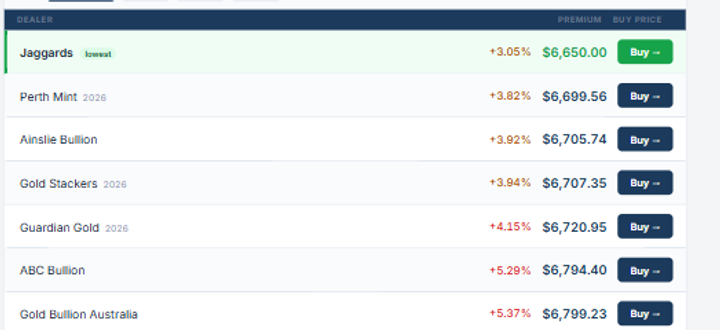
This is a structural headwind for silver investors buying in Australia that does not apply to gold buyers. It is not a reason to avoid silver, but it is an important factor in the total cost of ownership calculation. See current silver prices from all major Australian dealers on our silver price page, or compare silver coins and silver bars to find the lowest premium available today.
GST When You Sell Silver
When an Australian investor sells silver to a dealer, the transaction is handled differently from buying.
Dealers acquiring silver from private individuals use a different GST treatment to their retail sales. In most cases, a dealer buying silver from a private individual who is not registered for GST simply pays the agreed buyback price. The individual seller does not collect or remit GST on the sale.
In practice, the buyback prices you see on dealer websites are the amounts dealers will pay you. These are the net amounts you receive. GST is not added to your payout.
This means the 10 percent GST you paid on purchase is not recovered when you sell. Your cost base includes the GST-inclusive purchase price, and your sale proceeds are the buyback price. The ATO confirms that GST paid on a purchase forms part of the cost base for capital gains tax purposes, so it is factored into the gain calculation. But the GST itself is gone.
To compare current buyback prices from Australian dealers, visit our sell silver coins page.
Silver in an SMSF: Does GST Apply?
If you hold silver through a self-managed superannuation fund, the GST treatment is the same as for any other Australian buyer. The SMSF pays GST on silver bullion purchases unless the fund is registered for GST and meets specific conditions for claiming input tax credits.
Most SMSFs are not registered for GST. If yours is not registered, you pay the GST-inclusive price and cannot claim the GST back. If your SMSF is registered for GST, you may be able to claim input tax credits on qualifying purchases. This is a complex area that depends on the fund's activities and registration status. Consult your fund's accountant before assuming you can recover GST.
For gold, the situation is cleaner. Investment-grade gold is GST-free, so SMSF trustees buying gold do not pay GST regardless of the fund's registration status. If you are an SMSF trustee considering gold, read our SMSF gold investing guide for a full overview of the rules, storage requirements, and tax advantages.
Key Takeaways for Silver Buyers
Silver bullion in Australia attracts 10 percent GST on purchase. This GST is built into the dealer price and is not recovered when you sell. For investors comparing gold and silver on a total cost of ownership basis, the GST is an additional headwind for silver that does not apply to gold.
Investment-grade gold at 99.5 percent purity or above, including qualifying bullion coins, is GST-free in Australia. Silver has no equivalent exemption as of 2026.
The practical implication: if you are buying $10,000 of silver, approximately $909 of that total is GST that will not be recovered on sale. Factor this into your return expectations alongside the dealer premium and buy-sell spread.
Compare current silver prices across all major Australian dealers on our silver coins page and silver bars page. For the gold price, including a weight breakdown and live dealer comparison, see our gold price page.